As a self-proclaimed film geek, I have an appalling deficiency when it comes to Westerns, having for years dismissed the genre with a knee-jerk prejudice that comes of reducing all ideas to the prudery of political correctness. Films of cowboys-and-indians were only concrete manifestations of 1950’s chauvinism, of American Exceptionalism, and of Manifest Destiny. For years, they held little appeal for a cosmopolitan aesthete with excruciatingly modern sensibilities such as myself. Cody urged me to reconsider my stance, pointing out that classic Westerns had a huge influence on noir. He egged me on, knowing well my long-standing obsession with Bogart, and pointed out that most of my favorite films have a fair share of xenophobia, conservatism and misogyny, too.
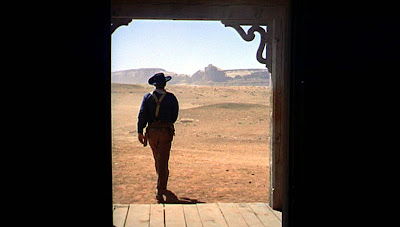
“The Searchers” was the first Western to make it into my DVD collection. John Wayne fascinates me as Ethan Edwards, ex-confederate soldier turned outlaw and ranger. As with many of Bogart’s characters, Ethan is a rogue who follows no law but his own moral code. And, without underestimating the irresistible appeal of bitter, self-destructive and emotionally-damaged men, such characters are compelling because of their innate purity. They operate within an ostensibly secular society, with powerful henchman and corrupt underlings and appear motivated by mercenary gain. But they remain detached, tough at the core, vulnerable only to love and/or a noble utopian vision. This is masculinity at its best.
I want to believe that such men exist in life—not necessarily in a specific romantic way but in a way that affirms the promise of goodness. The characters that I choose as my heroes reflect certain desired and missing elements in my current life: certainty, faith, honor and moral rectitude. Although “The Searchers” is a damn great film, there are retro elements within the film that are only appropriate for its era—i.e., the institutional racism, etc. We may ask whether there is a place for the mythic gunslinger in current pop culture.
“Serenity”is a modern sci-fi update of the traditional Western, a feature-length film adapted from “Firefly”, a television series that was cancelled after one season. “Failed TV shows do not get made into major motion pictures unless the cast and the fans believe beyond reason,” said creator Joss Whedon.
“Serenity”/”Firefly” offers its adherents a progressive hero, Captain Malcolm Reynolds (“Mal”) in an environment of infinite expansion, evocative of the untouched possibilities of the American west. Where Ethan Edwards was a confederate solider in the American Civil War, Mal was a Browncoat in the Unification War 2157, fighting against the Alliance, an authoritarian empire of the “core” planets which sought to impose centralize control over the frontier of the outlying solar system.
After the loss of Serenity Valley, a critical battle, Mal became a man adrift: “I’m a man without a rudder. If the wind blows northerly, I go north.” Captaining a Firefly-class ship named “Serenity” on the frontiers of the star systems, he and his crew become anti-government brigands for hire, robbing Alliance facilities and delivering frontier justice. Mal and his crew contract their services out for train robberies and raids on Alliance hospitals. Under the moral code of the populist outlaw, they do not steal from the poor, the exploited or the undeserving.
“We’re all just folks here,” says Mal, during a heist of the Alliance-owned security payroll center in the outer planetary rim. During the robbery, a marauding band of “Reavers” descend upon the town. Once human frontiersmen, Reavers became frenzied savages in the outer reaches of space, the sci-fi equivalent of the sadistic “indians” from traditional movie Westerns. They provide a counterpoint to the good outlaws of the frontier. Where both are unbound by the law, Reavers are unbound by moral code and, therefore, subhuman. As with the Comanche in “The Searchers”, Reavers rape, cannibalize, and mutilate their victims, taking human skins as trophies.
If the Reavers are the subhuman, the Operative is the superhuman. This figure, known only as “the Operative,” is an assassin par excellence, possessed of near supernatural physical ability and cultivated demeanor. Whereas Reavers have given in to animal instinct and savagery, the Operative is monstrous in his mechanical rationality, devoid of human emotion. And as an avenging angel (or demon), he “believes hard, kills and never asks why.”
It is the Alliance, not Reavers, that commits the most unspeakable acts in this narrative, sanctioning the rape of 11-year old River Tam, repeatedly penetrating her brain over the course of six years in a specialized school for the gifted. River’s descent into schizophrenia is evidence of systematic and institutional defilement, where the stripping of her amygdale means not only the loss of virginal innocence but also the loss of River’s humanity. The years of brutalization trained her to become a killing machine like the Operative.
As a narrative parallel, compare this with the abduction and rape of Ethan Edward’s niece, Debbie, at the hands of Scar, a Comanche chief. For Ethan, sexual commingling with a savage meant that Debbie was no longer human. The five years that he spent searching for his niece was not to bring her back but to destroy her: “Living with the Comanches ain’t being alive.”
Let me point out, dear reader, that in “Serenity”, the Alliance not Reavers are the real bad guys. This is because the Reavers are an outgrowth of the Alliance’s botched attempt to create a “world without sin”. Mal and the crew of plunge deeper into the outer rim of space to discover “Miranda,” a planet terra-formed to a stable inhabitable environment but where all inhabitants have died mysteriously. The chemical G-23 paxilon, thought to suppress aggressive human instincts, subdued 90 percent of Miranda’s inhabitants to inertia and eventual death. The remaining ten percent experienced the opposite effect, becoming violent and mentally unstable. They cut up their own faces, ripped their own flesh, and quickly devolved into savage beings.
Consider in the Miranda narrative the role of religion, which is simply the attempted classification of the human versus that which constitutes the sub- and super-human (David Chidester, Authentic Fakes). To eradicate sin and to “make people better”, the Alliance contrived to strip humans of humanity. This super-human act gives birth to a sub-human abomination. The creator therefore becomes as monstrous as its offspring.
In a traditional Western, the savage war is a symbol, which purpose was to justify the eradication of warlike savages at the hand of civilized Europeans. In “The Searchers”, the Ethan and the Rangers fought Scar and the Comanches—arguably, this resonated with the American presence in East and Southeast Asian during the 1950’s. In “Serenity”, the final battle is also a savage war, but one inverted from its most typical manifestation. Mal and his crew contrive a trap using Reavers to destroy the Alliance’s fleet. It is a war fought between the two extremes of sub- and super-human.
There is narrative significance in this inversion if we take Western as criticism of the collective anxieties of the current cultural and political climate. Just as Reavers are an unintentional by-product of the Alliance’s utopian vision, the current problems and misadventures in U.S. foreign policy is the unintentional outgrowth of the central government’s own political ideology. War on terror. A world without sin. There is not only a place but also a desperate need for a modern populist gunslinger.


No comments:
Post a Comment